

Why Digital Marketing Is Not Working for Most Businesses
I hear this almost every week.
A business owner sits across from me and says,
“We’ve spent money on digital marketing… but nothing is working.”
They’ve tried ads.
They’ve hired freelancers.
They’ve boosted posts.
And the result?
No leads. No sales. Just expenses.
Here’s the truth I’ve learned after working with multiple businesses:
Most businesses don’t fail at digital marketing because it doesn’t work.
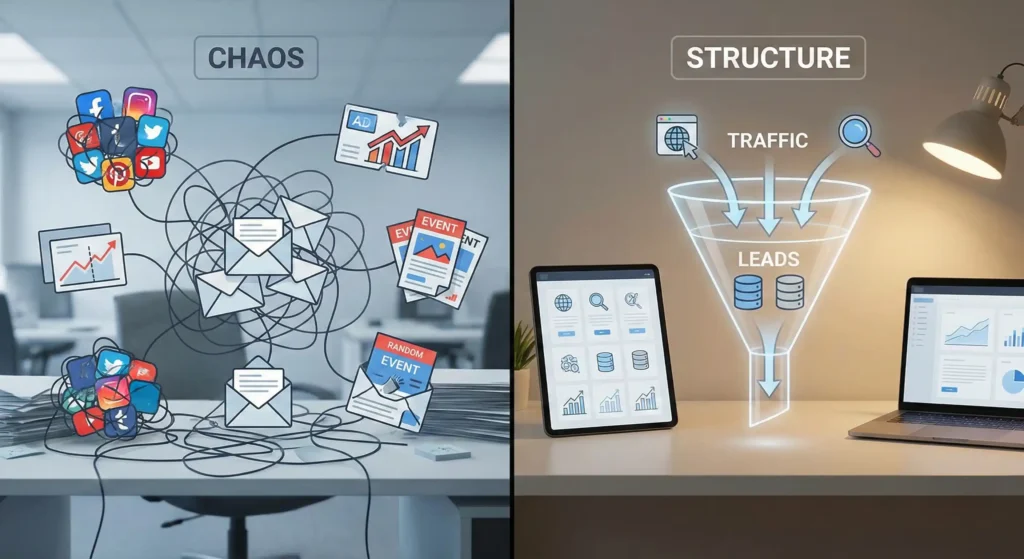
They fail because they’re doing the wrong things in the wrong order.
Let me break down the real reasons businesses lose money on digital marketing.
1. They Start With Ads Instead of Strategy
The first thing many businesses tell me is:
“Let’s run ads and see what happens.”
That’s the problem.
Ads don’t fix a weak business foundation. If your:
Website is unclear
Offer is weak
Target audience is wrong
Then ads will only help you lose money faster.
Before spending on ads, you need:
Clear positioning
A strong offer
A conversion-focused landing page
Otherwise, you’re paying for traffic that will never convert.
2. No Clear Target Audience
When I ask, “Who is your ideal customer?”
Most answers sound like this:
“Anyone who needs our service.”
That’s not targeting. That’s guessing.
Digital marketing works when you:
Target a specific audience
Speak their problems
Show a clear solution
The more specific your audience, the lower your cost and the higher your ROI.
3. Expecting Instant Results
Another common line I hear:
“We ran ads for 10 days and didn’t get results.”
Digital marketing is not a switch. It’s a system.
SEO takes time.
Content builds trust slowly.
Ads need testing and optimization.
Businesses that expect instant profits usually stop right before things start working.
4. Weak Website = Wasted Traffic
Many businesses invest in ads but ignore their website.
When I audit their site, I usually see:
No clear value proposition
Slow loading speed
No trust signals
Confusing navigation
Even if ads bring visitors, the website fails to convert them.
Traffic doesn’t make money.
Conversions do.

5. Chasing Trends Instead of Building Systems
One month it’s Instagram.
Next month it’s YouTube.
Then it’s WhatsApp marketing.
I’ve seen businesses jump from one platform to another without a clear strategy.
What actually works:
One primary channel
Consistent content
Long-term optimization
Digital marketing rewards consistency, not experimentation without direction.
6. Hiring Based on Price, Not Expertise
This is a hard truth.
Many businesses try to save money by hiring the cheapest freelancer or agency.
Then they come to me and say:
“We tried digital marketing before. It didn’t work.”
In most cases, the problem wasn’t digital marketing.
The problem was poor execution.
Good strategy + poor execution = poor results.
7. No Tracking or Data Analysis
When I ask,
“How many leads did you get? What was your cost per lead?”
The answer is often:
“We’re not sure.”
If you’re not tracking:
Cost per lead
Conversion rate
Customer acquisition cost
You’re not doing marketing. You’re gambling.
What Actually Works
From my experience, businesses see results when they focus on:
Clear positioning
A defined target audience
A strong website or landing page
Consistent content or SEO
Data-driven ad optimization
Digital marketing works.
But only when it’s treated like a system — not a shortcut.
Final Thought
If your digital marketing isn’t working, the problem is rarely the platform.
It’s usually:
The strategy
The messaging
The execution
I’ve seen businesses waste months chasing quick wins.
The ones that succeed focus on fundamentals, stay consistent, and optimize based on data.
That’s the difference between spending money on marketing…
and making money from it.
If your digital marketing isn’t delivering results, the problem is usually not the platform — it’s the strategy behind it.
If you want, I can take a quick look at your current setup and point out what’s working, what’s wasting your budget, and where the real opportunities are.
No sales pitch. Just a practical review based on what I see.